


CCTV Surge Protection for Reliable Surveillance Systems
2025-12-30


CCTV surge protection is the most critical part of your security setup if you want your cameras to stay online during a storm. You spend a lot of money on high-definition cameras, recorders, and storage to keep your property safe. However, a single lightning strike nearby or a spike from your power grid can destroy that entire system in a second. Most people protect their computers but forget that security cameras are sitting ducks on exterior walls and poles. These cameras act as antennas for electrical energy. By installing the right protection, you ensure your video feed never goes dark when you need it most.
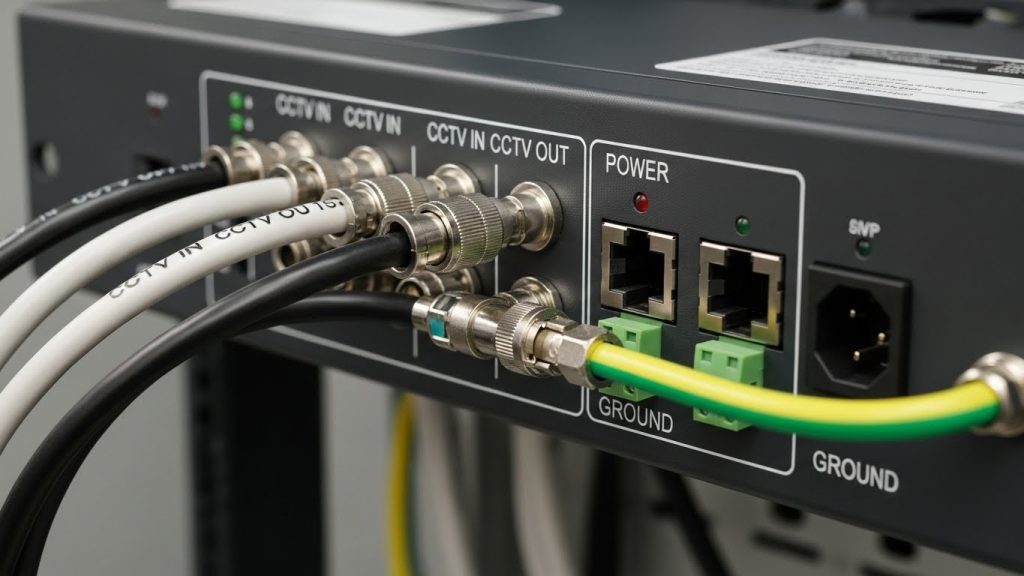
Why do you need CCTV surge protection for your security cameras?
You need CCTV surge protection to stop high-voltage spikes from traveling through your data and power cables to destroy your hardware. These spikes often come from lightning, power grid fluctuations, or large motors nearby. Without a protector, a surge fries your camera's sensitive image sensor and the recorder’s motherboard instantly.
Security systems are unique because they have wires running all over your building. Some cables go high up on your roof or out to a fence. These long copper runs are perfect paths for electrical interference. Even if lightning hits the ground a hundred feet away, it creates a magnetic field. This field induces a massive voltage on your camera wires.
A surge doesn't always come from the sky. Your utility company can cause spikes when they switch power on the grid. If you have an industrial site, large machines can send "noise" back into your lines. Using CCTV surge protection keeps these unwanted pulses out of your recorders. This prevents the high cost of buying new gear and the danger of losing your video evidence.
How does a surge protector keep your video recorder safe?
A surge protector keeps your recorder safe by acting as a gatekeeper on your data lines. It monitors the voltage coming from the camera. When it detects a spike, it instantly diverts the extra electricity to the ground. This stops the energy from reaching the delicate ports on your NVR or DVR.
Think of it like a safety fuse for your data. Under normal conditions, your video travels through the device without any change. You won't see any loss in picture quality. But the moment a surge hits, the protector switches to a conducting state.
It uses parts like gas discharge tubes or silicon diodes to catch the spike in nanoseconds. This speed is vital. Electricity moves fast, and your protector must be faster. By sending the surge into a ground wire, it saves your hard drives and motherboards. For Ethernet-based systems, using a signal surge protector SPD is the standard way to block these backdoor entries.
Key Threats to Your Surveillance System
| Threat Type | Source | Result Without Protection |
| Direct Strike | Lightning hitting the camera or pole | Fire, total equipment destruction |
| Induced Surge | Nearby lightning or magnetic fields | Blown ports, fried image sensors |
| Grid Spikes | Utility company power switching | Reboots, shortened equipment life |
| Static Build-up | Wind and dust on outdoor cameras | Ghosting in video, sensor degradation |
Where should you install surge protectors in a CCTV system?
You should install surge protectors at both ends of any outdoor cable run: one near the camera and one near the recorder. This "double-ended" approach is the best way to catch surges regardless of where they start. It protects the camera from house spikes and the recorder from outdoor strikes.
The Camera Side
If your camera is on a pole or an outside wall, it is at high risk. You should put a small SPD inside the junction box right behind the camera. This stops a strike from traveling down the long cable into your building. It also saves the camera itself if the surge comes from the ground.
The Recorder Side
The NVR or DVR is the "brain" of your system. If one camera gets hit, the surge can travel through the switch and kill all your other cameras too. You should put protectors on every port where a cable enters the building from the outside. This creates a "shield wall" around your most expensive hardware.
Power Entry Points
Don't forget the power supply. Whether you use a 12V box or Power over Ethernet (PoE), the power lines need protection too. A surge on your main AC line can travel through the power adapter and hit your cameras. Protecting the power entry completes your safety net.
What is the difference between IP and Analog CCTV protection?
The difference between IP and Analog protection lies in the connectors and the signals they handle. IP cameras use Ethernet cables (RJ45) and carry data plus power. Analog systems use coaxial cables (BNC) for video and separate wires for power. You must use the protector that matches your specific cable type.
Protecting IP Networks
Most modern systems are IP-based. They use Cat5e or Cat6 wires. You need an ethernet surge protector rj45 for these. These devices handle high-speed data and Power over Ethernet (PoE). If you use a standard protector on a PoE line, you might block the power or the device might get too hot.
Protecting Analog Systems
Older or "HD-over-Coax" systems use BNC connectors. For these, you need a coaxial cable surge protector. These devices protect the center pin of the coax cable while grounding the outer shield. Because the signals are different, you cannot swap an IP protector for an analog one.
How do you choose a protector for industrial or harsh areas?
To choose a protector for industrial areas, you must look for high-surge current ratings and rugged metal housings. These areas have more electrical noise from heavy machinery. You need an rj45 ethernet surge protector industrial that can handle multiple small spikes every day without failing or wearing out.
Industrial sites often have long cable runs through factory floors. These cables pick up interference from motors, welders, and lifts. A standard plastic protector might not be tough enough.
- Check the IP Rating: If the device is outside, it needs a high IP rating (like IP66) to keep out dust and rain.
- Look at the Housing: Metal cases block radio interference better than plastic ones.
- Verify the Mounting: Industrial units often use DIN-rails. This makes it easy to snap them into your existing electrical cabinets.
Why is grounding the most critical step in CCTV safety?
Grounding is the most critical step because a surge protector has no place to send the extra electricity without a solid ground wire. An ungrounded SPD is just a connector that offers no real safety. You must connect the ground lead of every protector to a verified house or building ground.
You can buy the best protector in the world, but it won't work without a ground. The surge will reach the SPD, find no exit, and continue into your camera.
- Use Thick Copper: Use at least a 12 AWG or 14 AWG wire for the ground.
- Keep it Short: The wire from the SPD to the ground should be as short as possible.
- Check Your Rods: Ensure your building has a proper ground rod driven into the earth.
- Avoid Loops: Connect all your protectors to the same ground system to avoid electrical "noise" in your video.
How do you install a CCTV surge protector yourself?
You install a CCTV surge protector by placing it in-line between the camera cable and the recorder. Connect the incoming "dirty" wire to the surge side and a short patch cable from the protected side to your gear. Finally, you must screw the ground wire to a grounded metal box or busbar.
Step-by-Step Installation
- Turn off the power: Shut down your NVR or pull the power from your camera.
- Plug in the "Line" side: Take the cable coming from the outside camera and plug it into the port labeled "IN" or "Surge."
- Plug in the "Equip" side: Use a short patch cable to connect the "OUT" or "Protected" port to your recorder.
- Attach the Ground: This is the vital part. Connect the green wire or ground screw to a known ground point.
- Test the Link: Turn everything back on and check that your video signal is clear.
What are the signs that your surge protector took a hit?
The signs that your surge protector took a hit include a "No Signal" message on your monitor, a dead port on your switch, or a red light on the SPD itself. Many protectors are designed to "fail safe." This means they permanently block the line to ensure no more electricity can get through to your gear.
If your camera goes dark after a storm, don't just throw the camera away.
- The Bypass Test: Unplug the SPD and plug the camera directly into the recorder. If the picture comes back, your SPD sacrificed itself to save your system.
- Look for Heat: If the protector smells like burnt plastic or has char marks, it took a large strike.
- Indicator Windows: Some models have a small window. If it turns red or stays dark, the internal fuse is blown.
Does Power over Ethernet (PoE) need special protection?
Yes, Power over Ethernet needs special protection because the cable carries both high-speed data and 48V-57V of DC power. A standard Ethernet SPD might see that constant 48V as a "surge" and try to block it. You must use a protector that is specifically rated for PoE, PoE+, or PoE++.
PoE-rated protectors are built to ignore the 48V power while still reacting to a 500V lightning spike. They also ensure that the power doesn't "leak" into the data wires, which can cause your cameras to reboot or flicker. If you use a "data-only" protector on a PoE line, it will likely get hot and fail within minutes.
How much should you spend on CCTV surge protection?
You should expect to pay between $20 and $50 for a single-port CCTV surge protector. Industrial or multi-port rack units cost between $150 and $400. While this might seem like a lot, it is a small fraction of the cost to replace a $500 camera or a $2,000 NVR.
Cost vs. Risk
| Component | Replacement Cost | Protection Cost |
| Outdoor 4K Camera | $300 - $800 | $35 |
| 8-Channel NVR | $400 - $1,200 | $50 |
| 24-Port PoE Switch | $500 - $1,500 | $150 (Rack Unit) |
| Hard Drive Data | Priceless | Included with SPD |
Buying protection is like buying insurance. You pay a small amount today to avoid a massive bill later. Most professional installers won't even give a warranty on a system unless it has proper surge protection.
Can a surge protector slow down your video or cause lag?
A high-quality surge protector will not slow down your video or cause lag, but a cheap or poorly rated one can. If you have a Gigabit network and use a 100Mbps protector, you will see a massive drop in performance. Always match the "bandwidth" or "data rate" of the protector to your camera's speed.
Data cables carry signals as fast electrical pulses. A poor protector "muffles" these pulses. This leads to "packet loss," which looks like stuttering or pixelated video.
- Cat5e vs. Cat6: Use a Cat6 protector for Cat6 cables to maintain high speeds.
- Low Capacitance: Look for this on the spec sheet. It means the device stays out of the way of your data.
- BNC Quality: For analog, poor connectors can cause "ghosting" or wavy lines.
How does humidity and salt air affect your protectors?
Humidity and salt air cause corrosion on the copper pins of your RJ45 or BNC ports, which can weaken your protection. In coastal areas or humid factories, you should use SPDs with gold-plated connectors or sealed "marine-grade" cases. This prevents rust from creating a gap in your safety path.
If your SPD is inside a box outdoors, temperature changes cause "sweating" (condensation). This moisture can short out the protector.
- Use a Sealed Box: Ensure outdoor SPDs are in an IP65 or higher enclosure.
- Check Yearly: Look for green or white crust on the connectors. This is a sign of salt damage.
- Grease the Pins: A tiny bit of dielectric grease can block moisture from reaching the copper.
Is fiber optic a better way to stop surges in CCTV?
Fiber optic is a better way to stop surges because glass fibers do not conduct electricity. Lightning cannot travel through a fiber line. If you have cameras far away in a parking lot, using fiber for that long run removes the "antenna" effect entirely. No electricity means no surge.
However, fiber is more expensive and harder to install. You still need power at the camera end, and that power wire can still carry a surge. Even with fiber, your recorder still has a power plug. So, while fiber solves the "long cable" risk, you still need basic protection for the remaining parts of your system.
Common Myths About CCTV Surges
Don't be fooled by these common misconceptions:
- "My cameras are under an eave, so they are safe." Lightning doesn't need to hit the camera to destroy it. A strike nearby travels through the ground and up your cables.
- "I have a lightning rod, so I'm protected." A lightning rod saves your building from catching fire. It does not stop the electromagnetic pulse from frying your computers.
- "Wi-Fi cameras don't need protection." While the signal is wireless, the camera still has a power wire. Surges can enter through that power plug and kill the camera.
How to verify your ground with a multimeter?
You can test your ground in two minutes. Set your multimeter to "Ohms" or "Continuity." Touch one probe to the ground wire of your SPD and the other to a known ground (like a copper water pipe or the ground pin of an outlet). You want to see a very low number, ideally under 1 ohm. If you see a high number or no "beep," your ground is weak, and your protector won't work.
Why you should avoid "extreme" cheap deals on SPDs
You will see generic protectors for $5 online. These often have nothing inside but a tiny fuse or even just a wire. They look real but offer zero protection against a real surge. A professional CCTV surge protection device uses gas discharge tubes and high-grade silicon that cost more to make. Don't risk a $5,000 system to save $20 on a fake device.
Protecting Your Security System from "Ground Loops"
A ground loop happens when your camera and your recorder are grounded at two different points with different electrical pressures. This shows up as "hum bars" or wavy lines on your screen. A good surge protector with an "isolator" can fix this. It levels the pressure between the two ends, giving you a crystal-clear picture and better safety.
Final Summary for Your Safety Plan
Check your system today. Are your outdoor cameras protected at the entry point? Is every ground wire actually connected to something? If not, you are one storm away from a dead system. Adding protection is the final step in building a professional security setup that lasts.
