


Power Quality and Surge Protection: What You Need to Know
2026-01-10


Power quality refers to the characteristics of electrical power that enable systems and equipment to operate normally without interruption or damage, and surge protection is a key part of maintaining it. In an era where industrial and commercial operations rely heavily on sophisticated microelectronics, even minor deviations from an ideal voltage waveform can lead to significant downtime. While many associate power quality with steady-state voltage levels, the mitigation of high-frequency transients is equally critical.
This guide provides an engineering perspective on how surge protection measures integrate into a broader power quality strategy to enhance electrical reliability and system voltage stability.
What Is Power Quality?
Power quality refers to the characteristics of electrical power that enable systems and equipment to operate normally without interruption or damage. In a perfectly "clean" system, the voltage waveform is a pure sine wave at a constant frequency and magnitude. However, real-world electrical systems are subject to various disturbances that deviate from this ideal state. Power quality is essentially a measure of how well the delivered power supports the reliable operation of its connected loads.
Maintaining high power quality involves managing waveform integrity, ensuring voltage stability (avoiding sags and swells), and keeping frequency variations within tight tolerances. It also requires the suppression of electrical noise and harmonics that can interfere with sensitive communication and control circuits. When power quality is poor, the results range from subtle software glitches and data corruption to the immediate physical failure of motor windings and power supplies.
What Are Common Power Quality Disturbances?
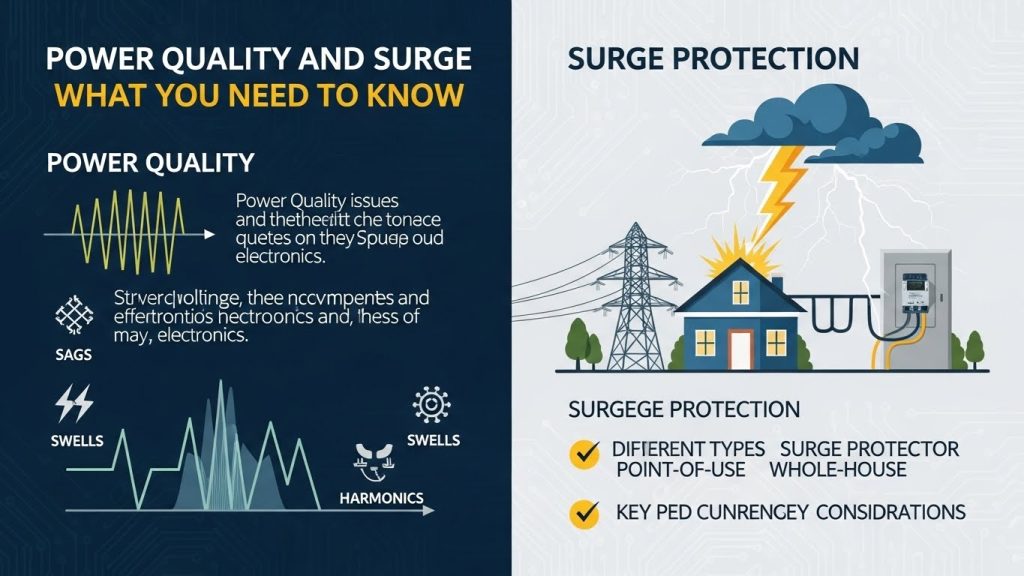
Common power quality disturbances include voltage sags and swells, transients, harmonic distortion, and frequency variations. Voltage sags, often called "brownouts," are short-duration decreases in voltage usually caused by starting heavy loads or utility faults. Swells are the opposite—temporary increases in voltage that can stress insulation. Harmonic distortion occurs when non-linear loads, such as variable speed drives or LED lighting, pull current in pulses, "polluting" the sine wave with multiples of the fundamental frequency.
Transients, however, represent the most volatile category of disturbance. These are divided into impulsive transients (sudden spikes) and oscillatory transients (ringing). While sags and swells might last for several cycles, transients are often measured in microseconds. Despite their brevity, their high energy and rapid rate of change make them the most dangerous disturbance to semiconductor-based electronics and high-precision automation systems.
What Are Transient Surges and How Do They Affect Power Quality?
Transient surges are sudden, short-duration voltage spikes that disrupt power quality and can stress or damage equipment. They essentially represent high-frequency "noise" of extreme magnitude. External sources, such as lightning or utility grid switching, can inject thousands of volts into a system. Internal sources are more common, occurring when inductive loads like motors or large transformers are switched off, causing a rapid collapse of magnetic fields that "kicks" a voltage spike back into the distribution network.
When a surge occurs, it momentarily destroys the voltage stability of the system. The high $dv/dt$ (rate of voltage rise) can puncture the dielectric insulation in motors and cables. Furthermore, surges can cause logic errors in digital processors by appearing as "false" data signals. Over time, repeated low-level surges degrade the junctions of microchips—a phenomenon known as "electronic rust"—leading to unpredictable equipment behavior and eventually permanent failure.
Why Is Surge Protection Important for Power Quality?
Surge protection is important for power quality because it limits transient disturbances that can degrade electrical performance and equipment health. While a Voltage Regulator or a Uninterruptible Power Supply (UPS) might stabilize long-term voltage levels, they are often too slow to catch the nanosecond-scale rise of an impulsive transient. Surge protection acts as a high-speed "safety valve" that triggers before the surge energy can propagate deep into sensitive internal circuitry.
By implementing robust surge protection, you ensure that the "transient" portion of power quality is effectively managed. This suppression prevents the cumulative stress on components that leads to premature aging and intermittent system crashes. In industrial environments, where a single production stoppage can cost thousands of dollars per hour, surge protection is the most cost-effective insurance for maintaining continuous, high-quality electrical performance.
How Do Surge Protective Devices Work Within Power Quality Strategies?
Surge protective devices detect excessive voltage and redirect or clamp transient energy to protect system integrity. Within a comprehensive power quality strategy, SPDs are placed at strategic points—usually following a "cascaded" approach. Under normal voltage, the SPD is "invisible" to the system, maintaining a high-impedance state. When a spike is detected, it switches to a low-impedance state in nanoseconds, creating a path of least resistance to the ground.
This operation directly supports waveform integrity. By "clamping" the spike, the SPD prevents the voltage from reaching levels that would cause insulation breakdown or catastrophic hardware failure. After the surge has been successfully diverted, the SPD must return to its high-impedance state without disrupting the normal power flow. This seamless transition is essential for ensuring that the protection measure itself does not become a source of power quality disturbances.
What Technologies Enable Surge Protection?
Surge protection uses technologies such as MOVs, TVS diodes, and gas discharge tubes to suppress transient overvoltages. Metal Oxide Varistors (MOVs) are the workhorses of the industry, capable of handling large amounts of energy and reacting in nanoseconds. They are composed of a non-linear material that drops its resistance as voltage increases. Transient Voltage Suppressor (TVS) diodes are semiconductor-based and offer even faster response times, though they are generally used for lower-energy applications like data lines.
Gas Discharge Tubes (GDTs) utilize an inert gas that ionizes into a plasma state during a surge, allowing it to carry massive currents. Many modern high-performance SPDs are "hybrid" units that combine these technologies. For example, a hybrid unit might use a TVS diode for its rapid reaction speed and an MOV or GDT for its heavy energy-handling capacity. This combination ensures the system is protected against both fast-rising, low-energy pulses and slower-moving, high-energy surges.
How Does Surge Suppression Differ From Other Power Quality Solutions?
Surge suppression specifically targets transient overvoltages, while other power quality solutions address sags, harmonics, or frequency variations. A common misconception is that a standard Power Strip or a basic UPS provides complete surge protection. In reality, most UPS systems are designed for backup power and voltage regulation; their internal surge suppression components are often small and can be easily overwhelmed by a significant transient event.
Contrastingly, Passive Filters or Active Harmonic Filters are designed to "clean" the sine wave of harmonic distortion caused by non-linear loads. They do not have the reaction speed or current-handling capacity to stop a lightning-induced surge. To achieve a truly reliable system, surge suppression must be viewed as a specialized layer of protection that works alongside—but is distinct from—filters, regulators, and backup power systems.
How Should Power Quality and Surge Protection Be Specified Together?
Specifying power quality and surge protection together requires understanding system voltage, disturbance exposure, equipment sensitivity, and coordination between devices. You must evaluate the "Maximum Continuous Operating Voltage" (MCOV) to ensure the protection doesn't trigger during normal voltage swells. Additionally, the "Voltage Protection Rating" (VPR) must be low enough to protect the most sensitive load on the circuit.
Coordination is key: a high-energy Type 1 SPD at the service entrance should be paired with lower-energy Type 2 or Type 3 devices downstream. This ensures that the primary surge energy is shunted at the building perimeter, while residual "let-through" voltage is managed closer to the sensitive electronics. When specified correctly, this layered approach provides maximum reliability without creating potential differences between different parts of the grounding system.
How Do Grounding and Bonding Impact Power Quality and Surge Protection?
Proper grounding and bonding reduce impedance paths and improve both power quality and surge protection effectiveness. An SPD is only as good as its connection to the earth. If the grounding path is high-impedance (due to long wires or poor soil conductivity), the surge current will create a voltage drop that elevates the local ground potential. This "ground bounce" can cause current to flow back into data cables or neutral lines, damaging equipment.
Bonding ensures that all metal enclosures and grounding points are at the same electrical potential. This prevents "loops" that can pick up electromagnetic interference (EMI), which is a common cause of power quality noise. For surge protection to work correctly, the diverted energy must have a clear, straight, and low-inductance path to the ground. Without a robust grounding and bonding foundation, even the most advanced SPD will fail to maintain power quality during a major event.
What Are the Key Takeaways on Power Quality and Surge Protection?
Maintaining power quality requires both managing steady-state characteristics and protecting against transient surges. By integrating high-speed suppression into your electrical infrastructure, you safeguard the long-term health and reliability of your assets.
- Holistic Approach: Power quality involves voltage, frequency, and transient management.
- SPD Role: SPDs are the primary defense against waveform-distorting transients.
- Technology: Use hybrid designs for a balance of reaction speed and energy capacity.
- Installation: Short lead lengths and robust grounding are mandatory for effective protection.
- Layering: Cascaded protection (Type 1, 2, and 3) provides the highest level of reliability.
What Is Surge Protective Device Response Time?
The reaction speed of an SPD is vital for catching transients before they reach sensitive circuits. While nanoseconds matter, the total system impedance is often more critical. Learn more about the technical details of surge protective device response time.
How Do SPDs Work for Surge Protection?
Understanding the internal physics of shunting and clamping helps engineers design better systems. Explore the step-by-step process of how surge protective devices work to redirect dangerous energy.
What Is Surge Suppression?
Surge suppression is the specific mechanism used to keep overvoltages within safe limits. It is a core pillar of any modern electrical reliability strategy. Read our in-depth explanation of surge suppression explained.
How Do SPDs Protect Electrical Equipment?
Ultimately, the goal of these systems is the safety of your connected hardware. Discover the specific methods and safeguards used in electrical equipment surge protection to extend equipment life.
Final Thought
Power quality is not a static state but an ongoing requirement for modern electrical systems. By recognizing that transients are a primary threat to waveform stability and equipment longevity, you can implement a surge protection strategy that truly supports the reliability of your infrastructure.
